In May 2024, Porto Alegre experienced one of the most severe flood events in its history. Extreme rainfall overwhelmed the hydrological system of the Jacuí Delta, submerging large parts of the metropolitan region. The impacts were especially visible in the Arquipélago, a group of inhabited islands shaped by sedimentation and water dynamics.
The floods exposed more than a natural hazard. The delta’s low elevation, unstable soils, and limited drainage capacity make it inherently vulnerable, yet the scale of the disaster revealed deeper structural issues. Decades of spatial inequality, informal urbanization, and insufficient infrastructure have intensified risks, disproportionately affecting already fragile communities.
The Arquipélago Project, developed within the framework of the UNDP, the TU Delft, and the Municipality of Porto Alegre, addresses these challenges by rethinking the relationship between urban development, ecology, and climate adaptation. Rather than focusing solely on technical solutions, the project investigates the processes that produce vulnerability, from governance structures to environmental degradation.
Within the context of this project, 68 international students worked on flood resilient architecture in the delta. The students joined the research team to deeply understand local challenges and explore how architecture might impact the local community in a positive way.
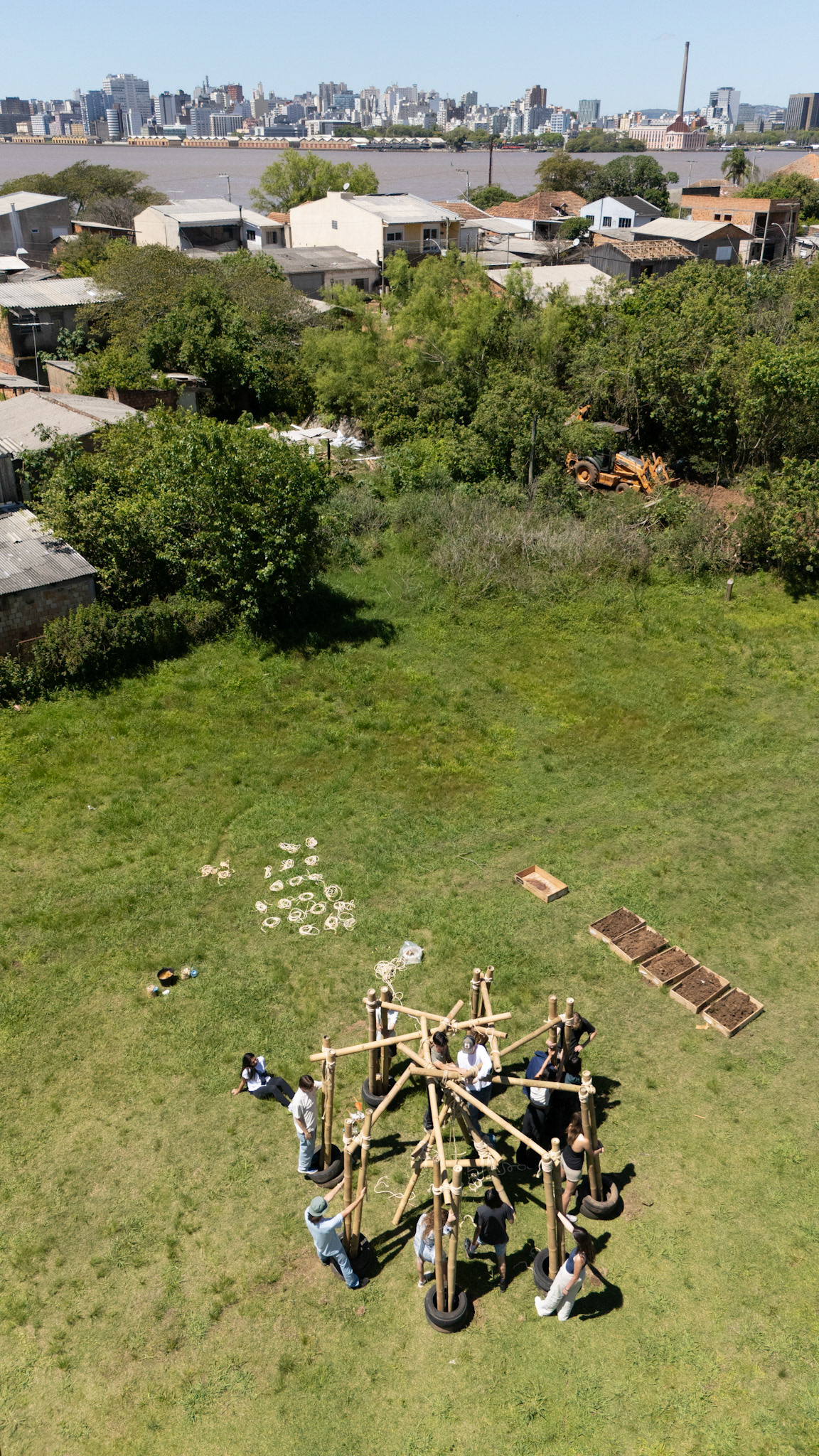
Master students from the course EXTREME Architecture teamed up with students from the Federal University of Rio Grande do Sul for a week of fieldwork in the delta. The students, guided by locals, spent the week acquainting themselves with the history, economy, constraints and possibilities of the communities who call the arquipélago their home. At the end of the week, the students built a bamboo pavilion to better grasp what locally workable architecture solutions might look like.
Flood-resistant architecture has been built before; it was not aim of the master course to repeat those solutions. Instead, the students were tasked to come up with out-of-the-box ideas and test them. This approach is visible in the concept developed by the students in their time back in Delft. Their work shows how local materials can be utilized effectively, but more importantly it highlights their curiosity and empathy towards local needs.